Evaluated 1M candidate profiles in five seconds to speed up hiring
Cut screening effort by 80-85% to focus on top talent
Saved $80K in recruiting fees across four specialist hires
Created auditable records to support fair, compliant hiring
Workerbee and Google Cloud build a living, company-specific Work Graph that connects workforce capabilities to company strategy.
Workerbee and Google Cloud build a living, company-specific Work Graph that connects workforce capabilities to company strategy.
Connecting workforce capabilities
to what the business needs next
Behind every successful business goal is a great team waiting to be built. Yet finding the right candidate—whether they work across the hall or are applying from outside the company—is a major hurdle for businesses.
Inside the company, qualified employees often remain invisible. Their achievements are scattered across emails, performance reviews, or even in managers' heads. Traditional HR systems capture important employee records, but titles and profiles rarely show the full picture of what someone has actually done or can do.
Searching outside the organization brings other struggles. Recruiters must sort through thousands of applications for a single job posting. Drowned in resumes and generic keywords, they struggle to identify the best candidate.
Hiring is about real people, not generic keywords. Partnering with Google Cloud allows us to cut through scattered workplace data and understand both what the work requires and what people have actually done, giving hiring managers more clarity in every decision.
Heiko Roth
Founder and CEO, Workerbee
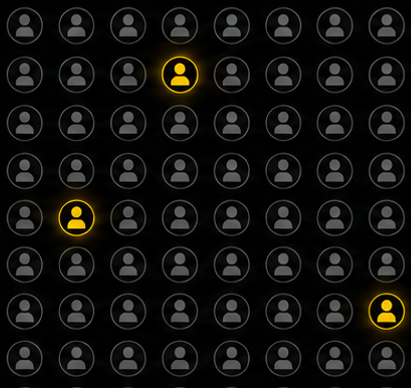
The whole hiring process can end up costing and taking much longer than most businesses anticipate and can keep goals out of reach.
Workerbee is changing that by helping companies cut through thousands of applicants and focus on the people worth a closer look. But, identifying strong talent is only part of the problem. The harder question is determining who is most likely to succeed in a specific role, inside a specific company.
For leadership, the question is larger still: does the company have the capabilities it needs to execute its strategy?
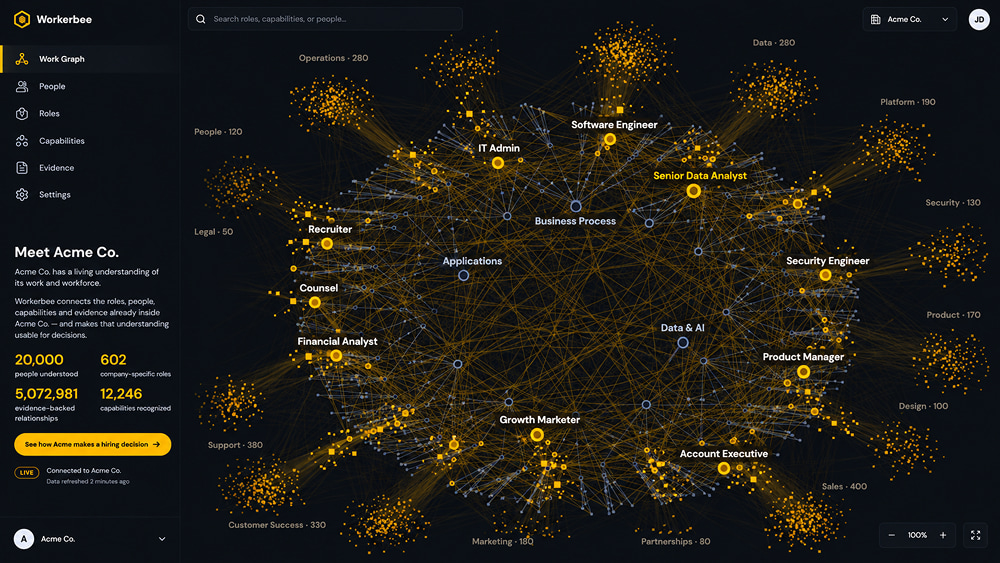
Powered by Google Cloud, Workerbee turns the systems, data, and workplace knowledge companies already have into a living, company-specific Work Graph. It creates a clear, unified map of human capability grounded in what the work actually requires.
AI is a foundation for Workerbee’s solution, but standard AI tools fail to solve the problem because they lack persistent memory of that context. For instance, each time a recruiter asks a question or modifies a search, the AI may need to reconstruct what the role requires, what matters to the company, and how the evidence should be interpreted. This wastes computing power, increases costs, and leads to unreliable results because the AI might rank the top candidate differently each time it reads through the information.
Additional challenges resulted from the fact that managing the quantity and variety of data required for all analytics can be daunting, especially for Workerbee’s larger enterprise customers. The company needed powerful and flexible data, infrastructure, and AI tools.
Creating a living, company-specific Work Graph with Gemini and BigQuery Graph
By organizing employee and recruitment data the moment it enters the platform with Gemini and BigQuery Graph, we can search millions of connections across an organization’s people, roles, capabilities, and experience in seconds. It slashes search costs while giving leaders instant, consistent, evidence-based answers.
Heiko Roth
Founder and CEO, Workerbee
To bring its Work Graph to life, Workerbee teamed up with Google Cloud to build a system that first makes a company’s definition of success explicit, then evaluates internal employees and external applicants against the same standard.
Gemini extracts relevant capabilities, experience, and evidence from the information companies already have—from resumes and portfolios for external applicants to project updates, performance reviews, and meeting notes for employees. Protected demographic attributes, such as age and gender, are excluded from the structured evaluation data, so they do not become part of the Work Graph used for ranking or decision logic. Workerbee then organizes the relevant evidence into the Work Graph, showing how work, role requirements, capabilities, experience, and people fit together.
When a manager asks Workerbee to identify the strongest people for a role, the system uses BigQuery Graph, a specialized tool designed to navigate connected data networks at high speed. BigQuery Graph acts like a GPS traversing the map, tracing the paths between applicant skills, experience, and company-specific requirements for the role in seconds.
Behind the scenes, Workerbee uses AlloyDB for PostgreSQL as its main database. While BigQuery Graph analyzes complex connections across people, roles, capabilities, and evidence, AlloyDB handles everyday data like candidate profiles, app settings, and user records.
By evaluating structured graph data instead of repeatedly reasoning over raw text, the system delivers fast, consistent, and evidence-based rankings. Because Workerbee only structures the underlying information once and reuses its insights, managers can run thousands of subsequent evaluations without repeatedly paying an AI model to reconstruct the same company context.
Working closely with Google Cloud product teams and DeepMind researchers, Workerbee is refining graph quality and testing Spanner Graph for operational workloads and live updates. The moment an employee completes a project, finishes a training module, or earns a certification, that new capability instantly updates across the Work Graph. This transforms talent data from static administrative records into a living asset that can evolve with the company.
Building the workforce to execute company strategy
By building on Google Cloud, Workerbee has achieved a speed and scale that transforms how companies make talent decisions. In a benchmark demonstrated to Google Cloud engineers, Workerbee checked one million candidate profiles against a complex job description in just five seconds using BigQuery Graph.
For external hiring, this speed means filling jobs in days instead of months while reducing recruiter screening effort by 80% to 85%. In early uses, customers saved $80,000 in recruiting fees across four specialist roles.
For internal hiring, the Work Graph reveals hidden talent inside a company. Leaders can instantly see which employees have the capabilities and experience for new roles before spending time and money on outside recruiting.
Hiring is the first use case for the Work Graph. Its broader value is helping leaders understand what capabilities they have, where the gaps are, and how work needs to change. It shows leaders whether the capabilities they have today match what the company will need to execute its strategy tomorrow. From there, Workerbee can identify gaps, surface internal talent, and map personalized learning pathways—including free Google courses—to help build the capabilities required.
Filling roles faster matters. The bigger opportunity is understanding whether the company has the capabilities to execute its strategy—who can step into critical work, what people need to learn, where to hire, and where AI can augment or automate.
Heiko Roth
Founder and CEO, Workerbee
As AI reshapes work, that same company-specific understanding can also help leaders determine what work should stay human, become AI-assisted, or be automated.
Workerbee also gives companies an auditable record of how talent decisions were made–preserving the standard, evidence, changes, and human judgment behind each recommendation. If a hiring manager changes the job requirements, the Work Graph logs that change automatically. It also preserves the factual evidence behind each ranking, showing how candidates were evaluated against explicit, role-related qualifications, not hidden criteria.
Together with Google Cloud, Workerbee is unlocking a clear view of what people can achieve. What once seemed impossible—instantly mapping millions of capabilities, notable achievements, and project experiences—is now a daily reality. That understanding becomes a living, company-specific asset that grows with the organization and can be applied across increasingly consequential workforce decisions.
Workerbee is the AI decisioning platform for workforce decisions. It builds a living, company-specific understanding of work, people, and capabilities, then applies that understanding to help companies make better decisions across hiring, mobility, development, and workforce planning.
Industry: Technology
Location: United States
Products: Gemini, BigQuery, BigQuery Graph, AlloyDB for PostgreSQL, Spanner Graph